Kroatiens största hamnstad, med en livlig Korzo, borgen Trsat högt över staden och en stark öl- och kulturscen. En perfekt bas för Opatija, Istrien och öarna i Kvarnerbukten.
Rijeka is Croatia's third-largest city. In the 19th century it was Hungary's seaport, within the Habsburg Empire. The grand palaces and the theatre date from that time. After the First World War the Italian poet Gabriele D'Annunzio occupied the city. It was then a free state for a few years, and from 1924 it belonged to Italy under the name Fiume. After the Second World War Rijeka became part of Yugoslavia. In 2020 it was a European Capital of Culture.
Rijeka is not a holiday resort but a real city, with lots of students, museums and concerts, also out of season. In January or February there is the carnival, one of the biggest in Europe. Autumn can be very rainy. Allow one or two days for the city itself. With the day trips below, you can easily fill a week.
Missa inte
01
Korzo and the City Tower
The Korzo is the car-free main street of the centre. It runs where the town wall once stood, when the sea still came right up to the town. Halfway along is the City Tower, one of the old town gates, with a Baroque portal and a clock mechanism from 1873 that still keeps time. The gate under the tower leads into the Old Town.
Tid1 hourTipsDo as the locals do and have a morning coffee on a terrace along the Korzo. Then walk on to the market.
02
Trsat
Trsat Castle stands high above the gorge of the Rječina river. The noble Frankopan family built it in the Middle Ages. In the 19th century the Austrian field marshal Laval Nugent bought the castle and had a mausoleum built there in the style of a Greek temple. From the walls you look out over the city, the port and the Kvarner Gulf. Close by is the Sanctuary of Our Lady of Trsat, one of the largest pilgrimage sites in Croatia. Legend has it that the house of Mary from Nazareth stood here from 1291 to 1294, before it moved to Loreto in Italy.
Tid2–3 hoursTipsTake city bus 2 up and walk back down the Petar Kružić stairs: more than 500 steps, the first from 1531, to the edge of the centre.
03
Molo longo
The breakwater that shelters the port is more than 1.7 kilometres long. For a long time it was off limits, but since 2009 it has been a pier for everyone to walk. At the end you stand in the middle of the bay, with the city and the mountains behind you and the islands in front of you.
Tid1 hourTipsGo around sunset. In a bora wind it gets cold and very windy out here, so bring a jacket.
04
City Museum in the Sugar Palace
A richly decorated Baroque palace from the 18th century, built as the office of the sugar refinery. In about 30 rooms the museum tells the story of Rijeka: sugar and tobacco, the port, the emigrants who left from here for America, and the world's first torpedo, tested here in 1866.
Tid1.5–2 hoursTipsThe palace is in the Benčić art quarter, a former factory site. There you will also find the Museum of Modern and Contemporary Art and the Children's House, with activities for children.
Sevärdheter
Old Town and Roman Gate
Behind the City Tower lies the Old Town, with small squares and churches. The Old Gate, also called the Roman Arch, is Rijeka's oldest monument. It was the main entrance to the Principia, the headquarters of a 3rd-century Roman military camp, when the town was called Tarsatica. The remains of the Principia have been excavated next to it.
St Vitus Cathedral
A round Baroque church, begun by the Jesuits in 1638. It is the only large Baroque rotunda in Croatia. Inside hangs a Gothic crucifix. Legend says it bled when a man threw a stone at it.
Leaning Tower
The bell tower of the Church of the Assumption dates from 1377. It stands on unstable ground and leans by about 40 centimetres. The tower is checked regularly and has not moved for a long time.
Croatian National Theatre Ivan Zajc
The theatre opened in 1885 with Verdi's Aida. It was designed by Fellner and Helmer, the Viennese architects of dozens of theatres across Central Europe. The auditorium ceiling was painted by Gustav and Ernst Klimt and Franz Matsch, before Gustav Klimt became famous.
Governor's Palace
The palace of the Hungarian governor, from 1896, stands just above the centre. It now houses the Maritime and History Museum, with ship models, sea charts and the splendid rooms of the palace itself.
Market and fish hall
The big market by the port, with iron-and-glass pavilions from the 1880s. The fish hall next to it dates from the early 20th century and is full of stone sea creatures and plants by the sculptor Urbano Bottasso. Come in the morning, when there is most to see.
Stränder
Concrete and pebbles
Ploče
The best-known and best-equipped city beach, in Kantrida in the west. It has lifeguards, a beach volleyball court and sea access for people with disabilities. The Kantrida swimming pools are right next to it.
Concrete
Kostanj
A small bay in the west of the city, specially equipped for people with disabilities.
Pebbles and rocks
Preluk
The westernmost bay of the city, on the border with Opatija. It is often windy, so you will see plenty of windsurfers.
Concrete, pebbles and rocks
Grčevo
One of the old beaches of Pećine, east of the centre. With a beach bar and showers.
Pebble beach
Brajdica
A beach in Pećine where your dog can go in the water too. There is another dog beach at Igralište in Kantrida.
Resa dit och runt
By air
Rijeka Airport is on the island of Krk, near Omišalj, about 30 kilometres from the city. A shuttle bus timed to the flights takes about 40 minutes to Jelačić Square in the centre. You can also fly to Zagreb, Pula, Trieste or Ljubljana, an hour and a half to two hours' drive away.
By train
Direct trains from Zagreb take just over four hours, through the forests of Gorski Kotar. Only a few run each day. The station is within walking distance of the centre.
By bus
The long-distance bus station is on Žabica, right in the centre. The bus from Zagreb takes two to two and a half hours.
Car and parking
From Zagreb the A6 motorway gets you to Rijeka in an hour and a half to two hours. Space in the centre is tight, so leave your car in a car park or at your accommodation. Since 2020 there is no toll on the bridge to Krk.
By catamaran
Jadrolinija catamarans leave the Riva for Cres and Mali Lošinj, calling at small islands such as Unije, Susak and Ilovik, and for Rab and Novalja on Pag. They do not take cars.
Getting around
You can explore the centre on foot. City bus 2 runs up to Trsat, and bus 32 follows the coast to Opatija and Lovran. Long-distance buses leave from Žabica, most city buses from Jelačić Square.
Var bo
City centre
Around the Korzo and the Old Town. Everything is within walking distance, including the bus and train stations and the boats. Lively in the evening, but parking is scarce.
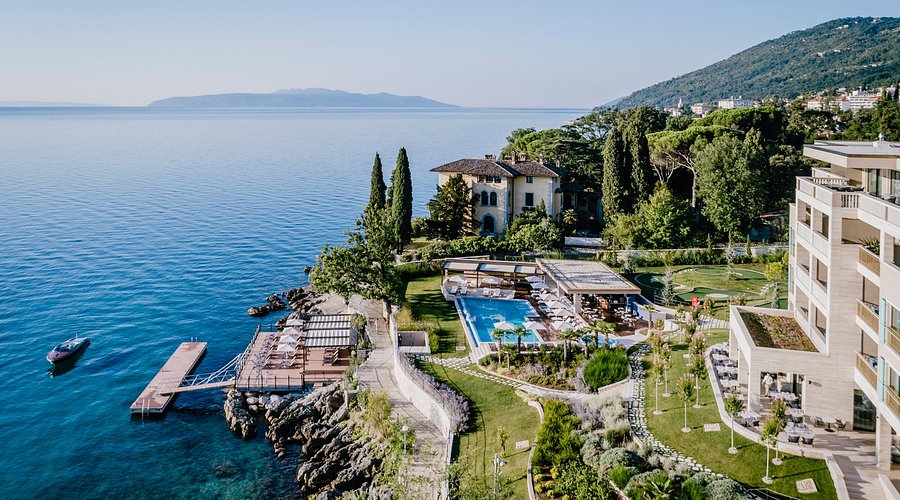
Ett litet lyxhotell vid strandpromenaden Lungomare i Ika, några minuter längs kusten från Opatija. Sexton art deco-inspirerade rum och sviter, många med terrass ovanför Adriatiska havet. Med Ikalia Spa, inomhuspool, utomhuspool med uppvärmt havsvatten, privat strand och restaurangen Nobilia.
Medelvärden från väderstationen Rijeka. Fetstilta månader är våra rekommendationer. Temperaturen är medelvärdet över dygnet; på dagen är det några grader varmare. Trängsel och priser är uppskattningar.
Fester och traditioner i Rijeka
Lokala fester och traditioner som är värda att planera resan kring.
7feb
Rijeka
Karnevalen i Rijeka
Från mitten av januari till askonsdagen; den stora paraden är söndagen innan
Nästa gång: söndag 7 februari 2027
Kroatiens största karneval. Under den internationella paraden tågar mer än tiotusen utklädda deltagare genom staden, inför upp till 150 000 åskådare. Sist kommer zvončari: män i fårskinn med stora klockor och masker med horn, som skrämmer bort vintern med sitt oväsen. Klockringarnas tåg från trakten kring Kastav finns på Unescos lista.
Datum och program kan ändras från år till år. Kolla den officiella webbplatsen strax innan du åker.
Mat och dryck
Kvarner scampi
Scampi from the Kvarner Gulf are known for their sweet flavour. You eat them grilled or 'na buzaru', stewed with white wine, garlic and parsley.
Jota
A hearty soup of beans, sauerkraut and potatoes, often with smoked pork. You will also find it in Istria and Trieste.
Frittata with wild asparagus
In spring people here pick wild asparagus. It goes into a fritaja, an omelette, often with a little pršut.
Maruni
Sweet chestnuts from Lovran, at the foot of Učka. In October Lovran celebrates the Marunada chestnut festival.
Local wine
White belica from Kastav and white žlahtina from Vrbnik on Krk.
Craft beer
Rijeka has a lively beer scene, with small breweries and bars in and around the centre. Our article with the best places is at the bottom of this page.
Dagsutflykter
20–30 min by car or bus 32
Opatija
Croatia's oldest seaside resort, with villas and hotels from Habsburg times. Walk the Lungomare, the coastal promenade that runs for about 12 kilometres from Volosko through Opatija to Lovran.
A medieval hilltop town above Rijeka, with narrow lanes, a town wall and views over the bay. On the first Sunday of October Kastav celebrates Bela nedeja, the festival of the young belica wine.
The mountain between Kvarner and Istria. On Vojak, the highest point at 1,401 metres, stands a stone lookout tower. On a clear day you can see the islands and sometimes the Alps. From the Poklon pass it is a walk of about 7 kilometres there and back.
The bridge gets you onto the island in no time. Visit the little town of Krk, the wine village of Vrbnik high on its rocks, where you can taste žlahtina, and Baška with its long pebble beach.
Forests and mountains in Gorski Kotar, home to bears, wolves and lynx. The Leska nature trail, just over four kilometres, starts at the visitor centre in Crni Lug. Bring a sweater: it is a good deal cooler than on the coast.